Showing posts with label Salmon Creek. Show all posts
Crunchers SMASH in Salmon Creek
Posted by Unknown in concrete processors, Demolition, I-205, I-5, I-5/I-205 junction, NE 139th Street Interchange, on-ramp, Salmon Creek on Wednesday, September 25, 2013
by guest blogger Heidi Sause
I met a man today who operates a concrete cruncher.
I know what you’re thinking, and I agree – that sounds like the coolest job ever! Concrete crunchers (technically, concrete processors) are built for maximum-strength, precision demolition work. Look at the jaws on this baby!
 |
| Cruncher jaws! |
 |
| Half a bridge |
The demolition work is part of a congestion-relief project in Salmon Creek. We’ve enlisted the crunchers because we need to remove an old on-ramp to make room for the new NE 139th Street interchange that’s being built over the I-5/I-205 junction. Also, The Hulk was busy.
In this photo, you can see the construction of the new interchange peeking out beneath the partially demolished ramp.
 |
| Old and New |
Fun fact: 100% of the concrete, steel and wood bits removed from the bridge are being shipped to plants to be recycled in future projects. See, Dr. Banner? You’re not the only one who gets to smash and be green! *Rimshot*
“T ’was the day of the closure and all through Vancouver…”
Posted by Unknown in closure, detour, detours, girders, I-5 closure, Salmon Creek, Vancouver on Friday, June 7, 2013
There’s a lot of hubbub surrounding the I-5 closure in Vancouver this weekend. Crews will close all lanes of I-5 in Salmon Creek at 11 p.m. Friday, June 7. The interstate will reopen to traffic by 5 a.m. Monday, June 10.
In the meantime…
Drivers are doing their prep work – making detour plans, downloading the WSDOT mobile app and planning for delays. We’re also preparing for this massive closure – here’s what it looks like in our world this morning.
Line ‘em up!

Six of the 12 girders are lined up on the side of I-5, waiting to be hoisted into the air over the interstate. Crews are looking to make the most of every second that I-5 is closed. By staging girders on site ahead of time, they won’t waste any down-time between girders.
Bracing for impact…

Ready for heavy lifting…
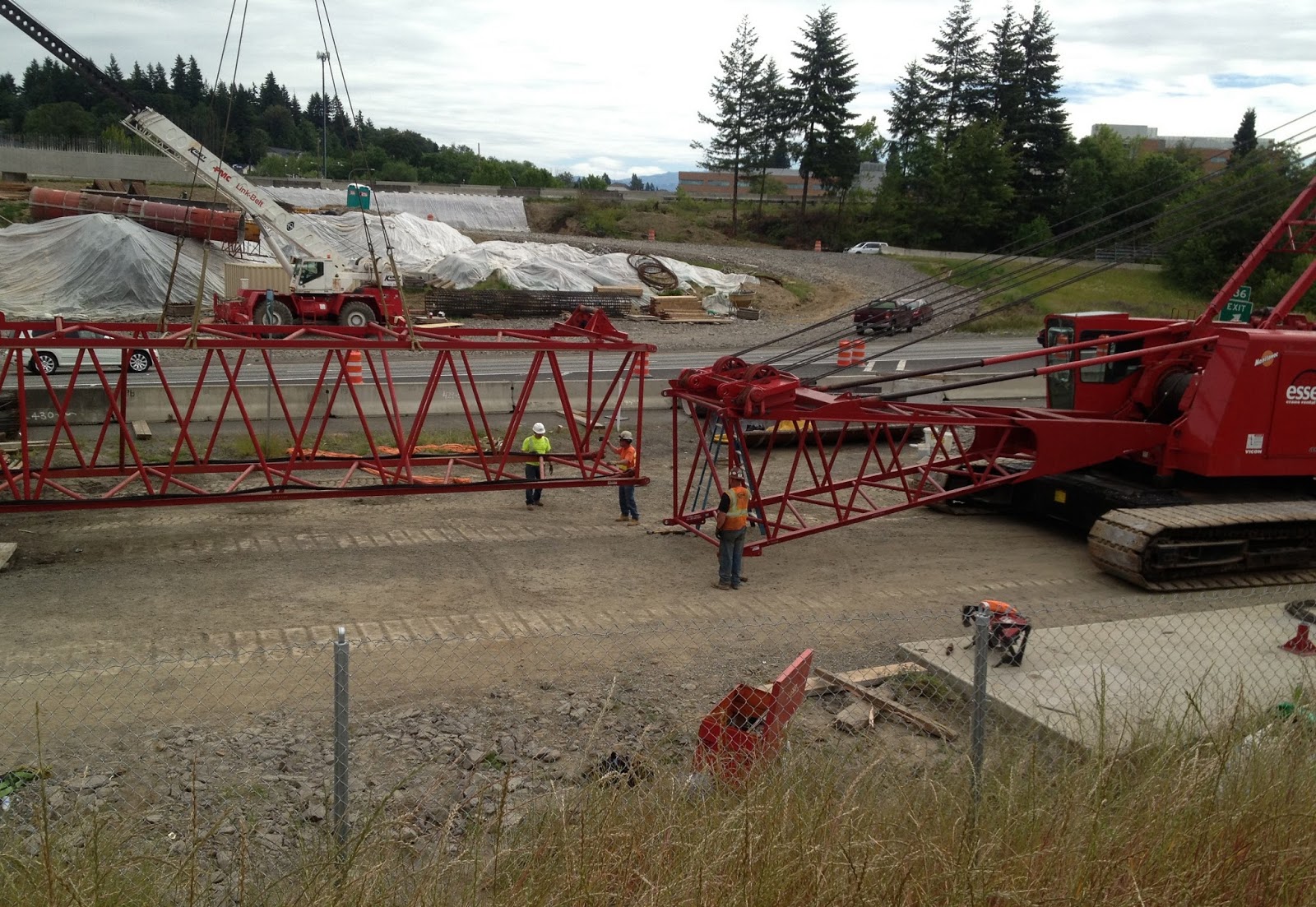
Crews are currently assembling the three, 500-ton cranes that will be doing all the heavy lifting this weekend. The size of the crane gives a little perspective to the scale of this weekend’s undertaking. Each girder is 175,000 lbs. – it will take three of these monster cranes to install them.
Fill ‘er up!

This one should be self-explanatory. It’s going to be a long weekend, and we’re in it with you.
Plan for delays if you’re traveling through Vancouver this weekend, and make sure to visit the project website to find more information about the closure location and detour routes. Good luck, all – we’ll see you on the other side!
Did you know we’re closing I-5 near Vancouver, June 7-10?
Posted by Unknown in Clark county, girder settings, girders, I-5/I-205 junction, NE 139th Street, Salmon Creek, Salmon Creek Interchange Project, setting girders on Wednesday, May 22, 2013
By guest blogger Heidi Sause
When Allen Hendy told me our contractor was going to shut down I-5 for a girder setting, I looked at him like he was out of his mind and let loose a dignified: Excuzemewhat?!
Allen is the project manager for the Salmon Creek Interchange project. For nearly three years now, his team and our partners at Clark County Public Works have been overhauling local roads and the I-5/I-205 junction in Salmon Creek. We’re on the last (and most exciting!) phase of construction – building a new interchange at NE 139th Street to reduce traffic congestion and improve safety in the busy area.
But here’s the pinch. We’re setting girders – essentially piecing together the bridge’s backbone – and there are a dozen girders that need to be hoisted into place directly above I-5. The installation process will close I-5 from 11 p.m. Friday June 7, to 5 a.m. Monday, June 10. Here’s a look at the span where we’ll be working:

Unlike many girder settings, this location isn’t level. I-5 is higher than the surrounding ground, which means the cranes essentially have to park downhill – below the launch spot of the girders and far below the installation target on top of the bridge piers. This less-than-ideal setup limits the cranes’ lifting power.
To address this complication, crews will park a third crane on southbound I-5 to assist with a complicated pick-and-switch-and-lift process to install the girders. Imaging a track relay, but with a 165-foot concrete and steel baton, and three cranes instead of runners. It will be one of the most complicated and difficult settings we’ve ever done, and it will take up to three hours to install each girder.
All that to say: the only way to complete this task is with a full closure of I-5. (I get it now, Allen!) We’re working to coordinate detour routes, identify potential “trouble spots” where traffic is more likely to back up and find ways to maintain access for local traffic and emergency vehicles. But no matter what we do, the closure will have a ripple effect on traffic in the entire area and there’s a huge potential for traffic headaches – even nightmares.
Here’s how drivers can help avoid traffic nightmares:
- Don’t drive if you don’t have to.
- If you have to drive through Clark County during the weekend of June 7-10, then visit our website to figure out if your route will be impacted.
- Familiarize yourself with the detour routes. (Pro tip: I-205 is your best friend.)
- Expect traffic congestion and plan for delays – give yourself some extra time to reach your destination.
- And as always, use the WSDOT tools at your disposal to know before you go! Visit our travel alerts page, call 511 and download the WSDOT app to access real-time traffic info during the closure.
Swinging into high gear on the Salmon Creek Interchange Project
Posted by Unknown in bridge, congestion relief, girder, girders, I-205, I-5, NE 139th Street Interchange, Salmon Creek, Salmon Creek Interchange, Salmon Creek Interchange Project on Thursday, March 14, 2013
 |
| Crane operators lift the 120-foot girder into place on the future NE 139th Street Interchange. |
It’s been a big week on the Salmon Creek Interchange Project. I’m talking high-flying, heavy-lifting, milestone-reaching BIG.
Now, I’m a hyper-enthusiastic transportation geek who’s prone to hyperbole even before reaching for my morning coffee – so you can imagine my delight when a 120-foot long concrete girder took flight on Tuesday.
Don’t get too excited (that’s my job); the flight was scheduled and carefully controlled by two masterful crane operators. But it was still a sight to see. Why? Because girder setting is one of the coolest things we do; it’s the point of construction when years of planning and engineering finally take shape in the field, and a reminder that we’re several 120-foot steps closer to a future with less traffic congestion in the busy Salmon Creek area.
The girders crews are placing right now form the backbone of the new Northeast 139th Street interchange, which will eventually carry drivers over the I-5/I-205 junction in the Salmon Creek neighborhood of northern Vancouver, Wash.
This week, our contractor installed 18 girders on the interchange bridge. They have another 16 scheduled for installation next week, which will bring the installed-girder tally up to 34. Thirty four down, 99 to go. (Ninety-nine girders to place on the bridge, ninety-nine girders to place…)
When complete, the interchange will significantly alleviate some of the gridlock on Northeast 134th Street, the parallel road that runs just south of current construction work. The new interchange also gives drivers another option to access the interstates, and provides direct access to Legacy Salmon Creek Hospital and the Washington State University Vancouver campus (go Cougs!).
We’re in the fourth and final stage of the $133 million congestion relief project, and on track to wrap things up in 2014. In the meantime, crews are in a frenzy of orchestrated activity: drilling bridge shafts, pouring concrete, realigning roads and – as enthusiastically mentioned – setting girders.
Sign up for project email updates and check out our Flickr site to follow the interchange during the upcoming construction season – it’s going to be a doozy.
Bridge building 101: Salmon Creek Interchange Project
Posted by Unknown in bridge, bridge building, NE 139th Street Bridge in Salmon Creek, rebar cages, Salmon Creek, Salmon Creek Interchange Project on Tuesday, October 16, 2012
by guest blogger Heidi Sause
Take a digital trip to the Salmon Creek Interchange Project in Vancouver for a high-flying journey of rebar, clamshells and cranes – here’s a step-by-step overview of how crews are building the base of the new interchange at Northeast 139th Street. (Note: Don’t try this at home.)
Step one: Dig a hole to China. Alright, not quite, but 130 feet deep is close enough. Crane operators use a giant oscillator to drill large metal casings (nine feet in diameter!) into the ground. A huge clamshell attaches to the end of a crane and bites mounds of dirt out from the inside of the casings.
 |
| Crews assemble one of the 54 rebar cages that will form the interior of the bride piers on the new NE 139th Street bridge in Salmon Creek. |
Back to bridges… The shafts are important because they form the foundation of the bridge. They are the crucial first step toward getting a bridge off the ground and in the air.
Step two: Build a rebar cage. Using a variety of large rebar, construct a continuous structural web of metal. Some of the rebar pieces are more than 2 inches in diameter, and each rebar cage weighs up to 80,000 lbs!
Step three: Use two large cranes and a complicated rigging set up, lower the massive metal web of rebar into the drilled shaft.
Step four: Pour 230 cubic yards of concrete into the shaft. Keep in mind, concrete needs to flow at a steady pace in order to set correctly. A well-orchestrated fleet of concrete trucks tags out at the pump truck to keep the pour flowing smoothly.
Step five: Remember the large metal casings mentioned in Step one? Crews will use the same casing pieces to drill 54 separate bridge shafts for the new interchange, and the casing can’t stay in the ground while the concrete sets. An oscillator steadily lifts the casing out of the ground so when the concrete goes in, the casing comes out.
Step six: Detach and remove each casing piece as it’s lifted above ground. Set aside for cleaning.
Repeat steps four through six until the concrete pour is complete and the hole-to-China has been replaced with a concrete bridge shaft, waiting to cure.
Then brace yourself and get ready to start over – one down, 53 to go!

 |
 |
 |
 |
 |
 |
 |
 |
 |
 |
 |
 |
 |
 |
 |


