Showing posts with label Tacoma. Show all posts
Washington State Ferries – working hard to keep you moving
Posted by Unknown in ferries, ferry, ferry crew, ferry painting, Puyallup, Samish, Save A Spot, state marine highways, Tacoma, Tokitae, Washington State Ferries, WSF on Friday, August 8, 2014
by Broch Bender
You won’t see any of our 22-vessel team competing for maritime gold like some of their stouter cousins plying Puget Sound.
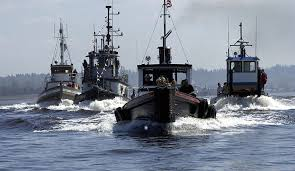 |
| (photo courtesy of: Friends of Olympia.blogspot.com) |
Our ships prefer the hard-working life of connecting communities and transporting goods day in and day out along our state marine highways.
 |
| (M/V Walla Walla at Colman Dock in Seattle) |
Ferries by the numbers
- 22.5 million riders and 10 million vehicles - What Washington State Ferries carries every year.
- 7 days a week, 21 hours a day – The hours we’re on the job.
- 1800 crew members, 450 departures a day from 20 terminals on 10 routes – That’s how we roll.
Even the best laid plans…
Let’s face it, the average age of our vessels is 38. Many are pushing 50 years old or more. Sometimes, no matter how careful we are to keep our vessels in working order, things can happen. And sometimes those things happen on multiple ferries at the same time!What happens when we’re down a few good ferryboats?
Our fleet is designed to keep a full-service schedule even if one or two vessels are out of service. If more than two are out of service at the same time, we do what we can to restore service to as many customers as possible.Moving ships or cancelling service is not a decision that we take lightly.
We try to match the largest available vessels to the busiest routes. For example, in July, when the 202-car Tacoma lost power on the busiest commuter route in the system (Bainbridge Island-Seattle) we moved the 202-car Puyallup from the Edmonds-Kingston route to make up the difference.
 |
| (Source: http://www.wsdot.wa.gov/ferries/traffic_stats/annualpdf/2013.pdf) |
We also ask ourselves, “Is there an alternate route?” Ferry service saves commuters time by zipping across the water instead of driving around the long way. In some cases, however the long way takes hours to drive, or is a non-existent route as in driving to the San Juan Islands.
During times of reduced service, we prioritize active vessels to ferry routes that don’t have viable alternate ways to get to a destination.
Maintenance – Essential to keeping ferries on the move
Throughout the day – Crews constantly monitor systems, perform routine and preventative maintenance and keep the ship in ship-shape.
On a weekly basis – More of the above, including tending to long-term projects such as tearing apart an engine for deep cleaning.
Quarterly inspections– Four times a year the U.S. Coast Guard checks all of the safety and life-saving equipment on the ferry to make sure it is in working order. The inspection also requires crew members to perform passenger safety and emergency rescue drills like the one pictured below.

Annual inspections– Just like a checkup at the doctor’s office, the ferry is evaluated from end to end, including the hard-working engine room. If the U.S. Coast Guard finds anything out of order, we tie-up the ferry and make repairs before returning it to normal service.
The “2 and 5” – Every two and five years, we take the ferry out of the water for a few weeks for a U.S. Coast Guard inspection. The looksee includes everything inspectors would normally comb through during the annual, plus the exterior hull and propulsion system.
 |
| (Above: crews practice lifesaving drills during an annual inspection) |
 |
| (Photo of the freshly painted TOKITAE at Vigor Shipyard in Seattle. ) |
Fleet feet – The crew that makes it happen
Our ferries aren’t complete without its dedicated crew.
 |
| (A WSF deckhand connects the passenger bridge to the dock at the Seattle terminal) |
Some employees work an 8 or 9 hour shift several times a week, others, like those in the engine room, work a 12-hour shift (day or night shift) for seven days in a row. They have a week off before returning to work the opposite shift for another week. Crew members alternate between day and night shift every other week.
All told, our 1800-person staff is just enough to cover all of the positions required to keep our fleet operating at full service. However, just like the rest of us, sometimes crew members get sick, or stuck in traffic, or have to attend to an emergency and are late getting to work.
Many traditional workplace environments can accommodate flexible schedules and last minute emergencies.
At Washington State Ferries, if every assigned crew member is not at their stations at the start of the shift, the shift can’t begin.
Crewing the vessels
We’ve got schedulers working around the clock filling regular service shifts and fill-in shifts for sea-going employees on vacation or at a medical appointment.
Nonetheless, filling vacant shifts within our fleet is challenging, particularly during the peak summer travel season. We are doing the best we can with the resources we have, including providing crew members with additional training so they are qualified to fill a wider variety of shifts.

First mates to oilers, it’s the norm around here to work overtime.
If you ever wondered what it takes to run a ferry boat, here's an overview of work stations, duties and pay rates. This example is for the Issaquah class, the hardest working boat in the ferry business.

Keeping it all in perspective
Your state ferry system has an overall service record of 99% reliability across the board. While we feel that is a strong record, it doesn’t minimize the real impacts that people like you experience when we do have incidents, and we sincerely apologize for that. We know we've been having some challenges this summer and we appreciate you bearing with us.
Interesting fact: Most U.S. airline carriers boast a 78% reliability. Looking to the future
We’re on course to provide the best service we can with the resources we have. Right now we’re in the thick of building the Samish, our second of three new 144-car ferries.

Starting in January 2015, we’re expanding Save A Spot, our vehicle reservation service, to the San Juan Islands route.

We are committed to getting you where you need to go safely. A big thank you goes out to all of our customers. We appreciate the opportunity to serve you.
I-5 gets rehabilitated in Tacoma
Posted by Unknown in concrete panels, concrete rehabilitation, I-5, I-5: 48th Street to M Street Concrete Rehabilitation, Tacoma on Friday, September 28, 2012
By guest blogger Claudia Bingham Baker
On budget and ahead of schedule – those words describe our I-5: 48th Street to M Street Concrete Rehabilitation project.
 |
Crews pour fast-curing concrete into an excavated 12’x15’ space to replace a broken concrete panel. All work was done at night to minimize traffic impacts. |
You may be wondering about all the other concrete panels out there that didn’t get this fresh start. Their turn is coming, when two more projects rehabilitate I-5 in a big way. The first project will rehab I-5 and build HOV lanes between M Street and Portland Avenue, and the second project will realign and rebuild I-5 through the SR 16 interchange and build an HOV bridge and ramps through Nalley Valley.
New cameras to help you know before you go
Posted by Unknown in Arlington, cameras, Everett, I-90, Olympia, Pierce County, SR 18 Interchange, Tacoma, Thurston County, traffic alerts, traffic cameras on Tuesday, March 6, 2012
How do you know what your commute is going to be like? If you’re like a lot of people, you might check out one of our many traffic cameras. We have several hundred cameras statewide showing road conditions along a variety of big interstates and smaller state highways. Add to that our data loops that give you a color-coded clue of whether traffic is stop-and-go (black) or free-flowing (green), and our travel alerts page, and drivers can get a pretty good idea of what to expect on the road before they ever get in the car.
But some stretches of highway are what we call our blind spots. With no cameras and no data loops, the only way to know what traffic is like is to be there. Or have ESP. And on the highways, the unexpected is rarely good news.
Fortunately for drivers, we’ve recently added to our arsenal of cameras. In February, we brought 18 new cameras online between Everett and Arlington and hooked up one new camera to show conditions at the I-90/SR 18 interchange. But wait, there’s more: Later this month, seven new cameras in Pierce and Thurston counties will give drivers a bird’s-eye view of traffic between Lacey and Joint Base Lewis-McChord. And by June, drivers in southern Thurston County can use six new cameras to check their commute, too.
If you’re adding it all up, that’s 32 brand spankin’ new cameras covering a whopping 36 miles of highway: 16 miles in northern Snohomish County, one new mile along I-90 in North Bend, 11 miles in Pierce County and eight in Thurston County. Goodbye blind spots, hello travel planning.
If you’re one of those people who’s more curious about how long your commute will take – in minutes rather than black and red dots on a map – you’re in luck, too. Travel times from Tacoma to Olympia (and vice versa) will start appearing Monday, March 12, on our Tacoma and Olympia traffic pages. Add that to the travel times already available on the Seattle Traffic page, and drivers can get a pretty good estimate of how long it will take to travel from Seattle and points north to Tacoma and points south. All with the click of a button (or two).
So the next time you head out for a road trip, or just hit the highway for your morning or evening commute, make sure to check out our new travel times and cameras. You might just save yourself some time (and frustration) now that you can know more before you go.
Project of the Week: Smashing the SR 16/I-5 bottleneck
Posted by Unknown in I-5, sr 16, Tacoma, WB Nalley Valley on Friday, June 24, 2011
By guest blogger Joe Irwin

The new viaduct improves flows – removing a bottleneck and weave from the interchange completely – and reduces the potential for collisions for drivers. Between 2005 and 2009, an average of 26 collisions occurred at the weave annually. This number is projected to decline considerably as a result of the new construction.
This is a great thing, especially for those who not-so-fondly remember heading north on I-5 to the Bremerton exit, running into to a ridiculous wedge that attempted to cram three lanes of traffic down to a single lane, and then immediately upon entering westbound SR 16 had these same drivers trying to weave into oncoming traffic also headed westbound on SR 16 from southbound I-5. As motorists attempted to either get on mainline 16 or take the Sprague Avenue exit, what followed was a poorly choreographed ballet that featured frantic cut-offs, brake lights and applause in the form of honking horns. A mess really.
That’s all coming to an end, though. And this was definitely reason for WSDOT to honk its own horn.
About 50 people, including federal, state and city representative gathered on Sprague off-ramp Wednesday, June 22 to mark the occasion.
The $139 million viaduct was $14 million under budget and completed several months ahead of schedule. Crews built 10 new bridges – including a segmental overpass connecting northbound I-5 to westbound SR 16 – since Guy F. Atkinson Construction started the $120 million, nickel-funded project in January 2009. The bridges, constructed from new approaches on 77 piers, span more than 7 acres.
It was a massive project, but it is just the beginning in terms of coming improvements for Tacoma traffic.
The work supports construction of the Eastbound Nalley Valley Project, which begins this fall and in 2013 will move eastbound SR 16 traffic onto a new viaduct structure, and open a new ramp between S. Sprague Avenue and eastbound SR 16. In 2020-2022, WSDOT returns to SR 16/I-5 to add HOV lanes, completing the overall project and helping the agency move Washington even more safely, quickly and efficiently.
It might seem like a ways off, and it is, but for anyone who has ever witnessed the SR 16/I-5 ballet in full swing, it’ll be worth the wait.

 |
 |
 |
 |
 |
 |
 |
 |
 |
 |
 |
 |
 |
 |
 |


