Showing posts with label Amtrak Cascades. Show all posts
What we’re doing to prevent landslides near rail lines
Posted by Unknown in Amtrak Cascades, gravity, landslide, mudslide, passenger train, rail, rain on Friday, January 2, 2015
By Barbara LaBoe
You can’t fight Mother Nature. But when it comes to landslides that block rail lines north of Seattle, we’re trying to call a truce.
 |
| This 1997 Department of Ecology picture of a landslide near Woodway, WA shows how devastating slides can be to property and rail lines. |
BNSF Railway Company owns and operates the railway. For each landslide on the north rail line, BNSF sets a minimum 48-hour moratorium on passenger rail service between Seattle and Everett. During that time, BNSF clears debris, repairs the tracks and checks the slope. While moratoriums are in effect, buses transport our Amtrak Cascades passengers between the Seattle and Everett stations to continue their train journeys.
We manage the Amtrak Cascades passenger rail service along with the Oregon Department of Transportation. Amtrak operates the service for the two states. So we take train safety and landslide disruptions seriously.
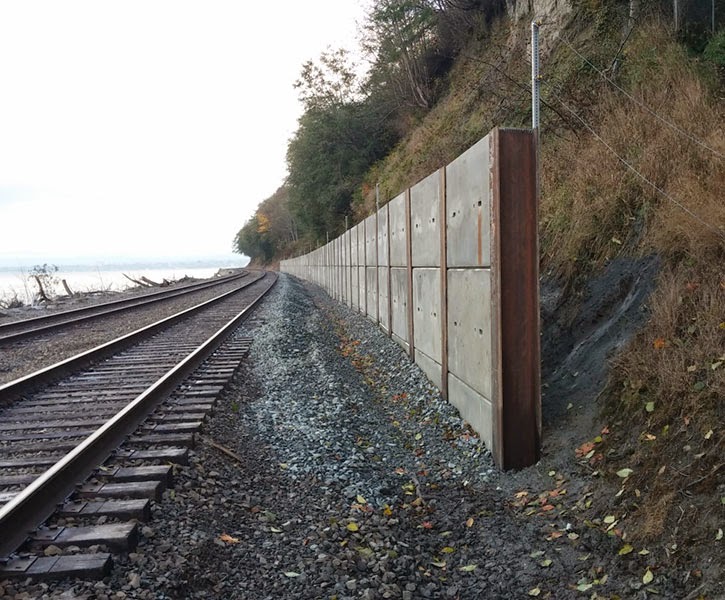 |
| Retaining walls, like this one, help catch and contain landslide debris before it can reach the tracks. |
We also, along with other work group members, held three educational open houses in communities along the north rail line to allow landowners to learn about landslide risks and prevention on their property. We met with mayors and city councils this year in Mukilteo, Edmonds and Everett about the issue. And a brochure with information and prevention tips (pdf 340 kb) was mailed to landowners along the affected rail corridor. In some cases, preventive measures are simple, such as planting native vegetation to prevent erosion and reduce the risk of landslides. New or reworked drainage systems also can help stabilize the slope and safeguard property -- as well as the rail lines. As part of this process, BNSF also agreed to waive permit fees through April 2015 for landowners who connect to the railroad’s drainage system.
- Retaining walls to catch landslide debris before it hits the tracks.
- Slide detection fences to give early warnings of active landslides.
- Improved drainage systems.
- Erosion control.
 |
| Stabilizing land and reducing the steepness of a slope, as shown here near Mukilteo, can also help prevent landslides. |
Of course, there’s never a 100 percent guarantee when you’re dealing with landslides. But by addressing landslide risks and prevention head-on, we hope to reduce at least some of Mother Nature’s impact.
Frustrated with mudslides along the Amtrak Cascades rail line
Posted by Unknown in Amtrak Cascades, mudslide on Wednesday, February 16, 2011

The last three months have been very frustrating, for you and us. We’re working hard to support, improve, and promote Amtrak Cascades as a viable transportation option. When the trains aren’t running, it impacts us all.
It is expected that we will have some mudslides along the Amtrak Cascades rail line between October and March, but this is ridiculous! Normally, we average anywhere from three to 10 mudslides over a six-month period, but in the last three months we’ve had nearly 20.
There were 16 mudslides that kept 90 trains from reaching their destination in Dec. 2010 alone. Seventy-eight of those trains were on the Seattle to Vancouver, B.C., leg. This happens to be our most mudslide-prone problem area.
What’s even worse is that any time there is a mudslide, regardless of how severe, an automatic 48-hour moratorium is imposed on passenger rail service. All passenger rail service comes to a halt, and as you can imagine, this is very inconvenient for passengers, Amtrak and us. Adding to the frustration is the fact that the moratorium doesn’t apply to freight rail service.
Obviously, this is done for safety reasons. Freight trains carry goods and passenger trains carry people. As you’d expect, people rate higher than a train carrying athletic shoes and televisions. Plus, it is important to ensure that the area where a mudslide occurred is stable before sending passenger trains through.

What are we doing about the mudslides, you ask? There are more than 60 areas along the 466-mile route for Amtrak Cascades that have been identified as at risk for mudslides. That’s a lot of area to cover. The majority of mudslides occur in the Everett area. There are also a decent number of mudslides in British Columbia that affect our trains.
This not only affects Amtrak Cascades, but also Sound Transit’s Sounder and the Amtrak Coast Starlight long-distance train and BNSF Railway freight trains. We are working with Sound Transit, Amtrak and BNSF to find a solution. The biggest challenge is funding. Before we can start any improvements, we have to complete an environmental assessment (EA) to determine potential key environmental impacts before beginning any construction. There is currently no funding for the EA – without it, we can’t begin construction to fix the problem.

In the meantime, we hope that the rain and mudslides subside so the trains can continue running unimpeded. Amtrak Cascades finished 2010 with extraordinary ridership totals (838,251 an all-time high) and we added free Wi-Fi at the end of January. Kudos to our partner Amtrak for doing their best to get people where they need to go in spite of the mudslide challenges.
Let us know what you think of the new Amtrak Cascades advertising campaign
Posted by Unknown in advertisement, Amtrak Cascades, rail on Thursday, October 21, 2010
We’ve launched a new advertising campaign for Amtrak Cascades this fall. The “Verbs” campaign is designed to educate people about the benefits of train travel and highlights the wide variety of things people are able to do on a train, but are difficult or impossible to do with other forms of transportation. Each element
 |
| Example of an ad you may see as part of this campaign, "Tweet to Vancouver B.C." |
The ads are out in the Seattle, Portland, and Vancouver, B.C. metro areas and you can see them locally here in Seattle on Sounder trains, Sound Transit Link Light Rail, outdoor billboards (downtown Seattle billboard tri-vision at Valley & Fairview), and on-line at KING 5 news, Weatherbug, and KOMO News.
 |
| Newspaper Ad |
Let us know what you think about the new campaign!
UPDATE: Wi-Fi is coming on-line on board Amtrak Cascades in December. We are finishing up the testing phase to make sure it is working correctly and will launch the service as soon as that is completed. So you will be able to YouTube, Skype, Tweet and more on Amtrak Cascades!
What exactly is “high speed passenger rail”?
Posted by Unknown in Amtrak Cascades on Friday, January 29, 2010

There seems to be some confusion on what exactly is High Speed Passenger Rail. Many people keep asking - Will this be like bullet trains? Will we be able to zip between Vancouver, B.C. and Eugene, OR at 150 miles per hour? Well, not today or in the near future, but a possibility we are working towards in the long term.
Amtrak Cascades trains travel at a maximum speed of 79 mph today. Although our trains are designed to go as fast as 125 mph, we are restricted to 79 miles per hour due to Federal Railroad Administration (FRA) regulations, track conditions, rail traffic congestion, and our geography (mountains, water, lots of curves, etc.).
What this does mean is that Amtrak Cascades will continue to travel at 79 mph, but we will be able to work towards incrementally increasing the speeds to 90 mph and eventually 110 mph. Now, bear in mind, this is not 110 mph non-stop between Vancouver, B.C. and Eugene, OR, as we do have to stop at 15 intermediate cities along the way. This means that there will be bursts of speed in designated “straightaways” where we can sustain these speeds.
There has been a lot of conversation about high speed rail recently because of some exciting news we got on Wednesday. This exciting news was in the form of a $590 million ARRA award through the High Speed Intercity Passenger Rail (HSIPR) Program.
WSDOT applied for over $1.3 billion in October 2009 for the Pacific Northwest Rail Corridor (PNWRC) .
What does this mean for Washington? As a result of this funding, two additional daily Amtrak Cascades round trips may be added between Seattle and Portland, for a total of six. Even better, the projects that this funding will help complete will help Amtrak Cascades trains be more on-time and reliable. This alone will be a significant benefit to those of you who have ever experienced train delays.
An amazing fact about this recent sum is that Washington State has invested over $331 million alone in support of high speed passenger rail over the last 15 years. To receive federal support of $590 million is a huge boost that will help improve the Amtrak Cascades service tremendously. And we will have more opportunities to apply for additional federal funding from the $2.5 billion set aside for high speed rail in the federal transportation appropriations bill approved in December 2009.
Amtrak Cascades renovations - first look
Posted by Unknown in Amtrak Cascades on Thursday, December 3, 2009
by guest blogger Vickie Sheehan
We are working with Amtrak to get ready to begin the next phase of renovations to the Amtrak Cascades train fleet. First up is the complete renovation of the Bistro and Lounge cars, in addition to adding Wi-Fi (yay!) and upgrading the video system. The renovation will begin shortly after the conclusion of the 2010 Winter Games in Vancouver, B.C. this March. We have a concept drawing of the renovated Bistro car ready and want you all to take a look and let us know what you think!
Here is the current Bistro car:

Here is the proposed redesign:

Leave us your comments and any suggestions you have on what improvements you would like to see on the Amtrak Cascades trains below or send us an email.

 |
 |
 |
 |
 |
 |
 |
 |
 |
 |
 |
 |
 |
 |
 |


