Mudslide blocks SR 20
Posted by Unknown on Thursday, July 30, 2009
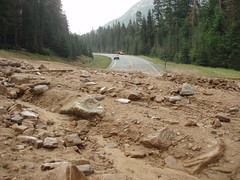
Mudslide blocks SR 20
Originally uploaded by Washington State Dept of Transportation.
On July 29th a mudslide west of Rainy Pass closed SR 20 in both directions at the east- and west-side closure gates. They had about 300 yards of mud and debris in a 10-foot-deep swath across the highway to remove, and needed to ensure the slope is stable before they reopened the road.
Where is Rainy Pass? www.wsdot.wa.gov/Traffic/Passes/NorthCas cades/map.htm.
The gates were closed on the west side just east of Diablo (milepost 134) and 14 miles west Mazama (milepost 171) on the east side. The gates were manned overnight to make sure anyone camping or hiking in between the gates could get out.
The slide was reported about 4 p.m. Wednesday, July 29, and responding crews began bringing in equipment and working last night. They stopped at dusk because it was too dangerous to work in the area in the dark. Crews were back early this morning. How quickly they can safely remove the debris and ensure that the slope is stabilized will determine when the highway reopens.
This area (nearly a mile high) had been hit with fast moving thunder, lightning, rain and hail storm cells all week. The slide was triggered by a thunderhead that passed through Wednesday afternoon which went on to start some 20 fires from there to Loup Loup Pass, 60 miles further east.
The road was reopened on July 30 at 3:15 p.m.
You can also check the North Cascades Web page for more information - www.wsdot.wa.gov/Traffic/Passes/NorthCascades/.
Working in the heat
Posted by Unknown on Wednesday, July 29, 2009
 When it comes to the weather, sometimes we just can’t win.
During the winter, it’s hard to get much road work done because it’s either too wet, too cold or both. And if you look back at our winter blog posts, we were waiting impatiently for the warm, dry summer weather.
Well, it’s summer. And, depending on the day, it’s either been warm and dry or painfully hot and humid. This week has been mostly the latter. For the most part, we’d rather be working in this weather. But the heat and humidity come with their own set of challenges for our crews.
The most obvious challenge for crews is simply working outside for eight to 10 hours every day on the hot pavement. If it’s 90 degrees outside, it feels even hotter for crews standing on a road that’s just soaking up the heat. And for paving crews…well, you can imagine how scorching that must be.
Needless to say, keeping hydrated is key for everyone. Crews are drinking tons of water before they start their day, during the heat of the day and after they’ve finished work. And everyone stays on high alert for signs of heat exhaustion: disorientation, profuse sweating, nausea or dizziness. Another less-apparent challenge for crews is compensating for the effect the heat and humidity have on asphalt and concrete. We know what you might be thinking: Aren’t you always worried about bad weather? Isn’t this hot weather a good thing? Yes … and no.
When we pave with asphalt, that asphalt goes down at 300 degrees. And at that temperature, it’s a lot like cookie dough when it gets taken out of the oven: soft and gooey. Naturally, we have to wait until it cools down before we can let traffic drive on it. That’s where the heat and humidity come into play.
When we put down hundreds of tons of 300-degree asphalt, it’s a very concentrated mass of heat. Consequently, it takes a long time for that heat to dissipate and the asphalt to reach a temperature suitable for traffic – 150 degrees or cooler. When the surrounding air is 80 or 90 degrees, it’s much harder for that heat to dissipate. Add in the humidity, which makes the ambient air temperature feel even warmer, and the asphalt will take even longer to cool.
Concrete has exactly the opposite problem: It cures too quickly in the heat. Unlike asphalt, concrete needs humidity to cool and cure properly. When it’s too hot out, water evaporates out of the concrete too quickly and can lead to cracking. Typically, crews blanket the fresh concrete with visqueen (they look like giant white tarps) to help trap the moisture. When it’s extra hot, crews have to work at warp speed to cover up the concrete before it gets too hot. They’ll also layer burlap rags soaked in water atop the fresh concrete and then cover it with visqueen to trap even more moisture.
So while we may have to do a little bit of extra planning when it’s this hot out, we’re taking advantage of the summer weather to get as much work done as possible.

 |
 |
 |
 |
 |
 |
 |
 |
 |
 |
 |
 |
 |
 |
 |


