Showing posts with label congestion relief. Show all posts
Swinging into high gear on the Salmon Creek Interchange Project
Posted by Unknown in bridge, congestion relief, girder, girders, I-205, I-5, NE 139th Street Interchange, Salmon Creek, Salmon Creek Interchange, Salmon Creek Interchange Project on Thursday, March 14, 2013
 |
| Crane operators lift the 120-foot girder into place on the future NE 139th Street Interchange. |
It’s been a big week on the Salmon Creek Interchange Project. I’m talking high-flying, heavy-lifting, milestone-reaching BIG.
Now, I’m a hyper-enthusiastic transportation geek who’s prone to hyperbole even before reaching for my morning coffee – so you can imagine my delight when a 120-foot long concrete girder took flight on Tuesday.
Don’t get too excited (that’s my job); the flight was scheduled and carefully controlled by two masterful crane operators. But it was still a sight to see. Why? Because girder setting is one of the coolest things we do; it’s the point of construction when years of planning and engineering finally take shape in the field, and a reminder that we’re several 120-foot steps closer to a future with less traffic congestion in the busy Salmon Creek area.
The girders crews are placing right now form the backbone of the new Northeast 139th Street interchange, which will eventually carry drivers over the I-5/I-205 junction in the Salmon Creek neighborhood of northern Vancouver, Wash.
This week, our contractor installed 18 girders on the interchange bridge. They have another 16 scheduled for installation next week, which will bring the installed-girder tally up to 34. Thirty four down, 99 to go. (Ninety-nine girders to place on the bridge, ninety-nine girders to place…)
When complete, the interchange will significantly alleviate some of the gridlock on Northeast 134th Street, the parallel road that runs just south of current construction work. The new interchange also gives drivers another option to access the interstates, and provides direct access to Legacy Salmon Creek Hospital and the Washington State University Vancouver campus (go Cougs!).
We’re in the fourth and final stage of the $133 million congestion relief project, and on track to wrap things up in 2014. In the meantime, crews are in a frenzy of orchestrated activity: drilling bridge shafts, pouring concrete, realigning roads and – as enthusiastically mentioned – setting girders.
Sign up for project email updates and check out our Flickr site to follow the interchange during the upcoming construction season – it’s going to be a doozy.
I-5 gets smarter on Aug. 10
Posted by Unknown in congestion relief, Smarter Highways on Friday, July 30, 2010
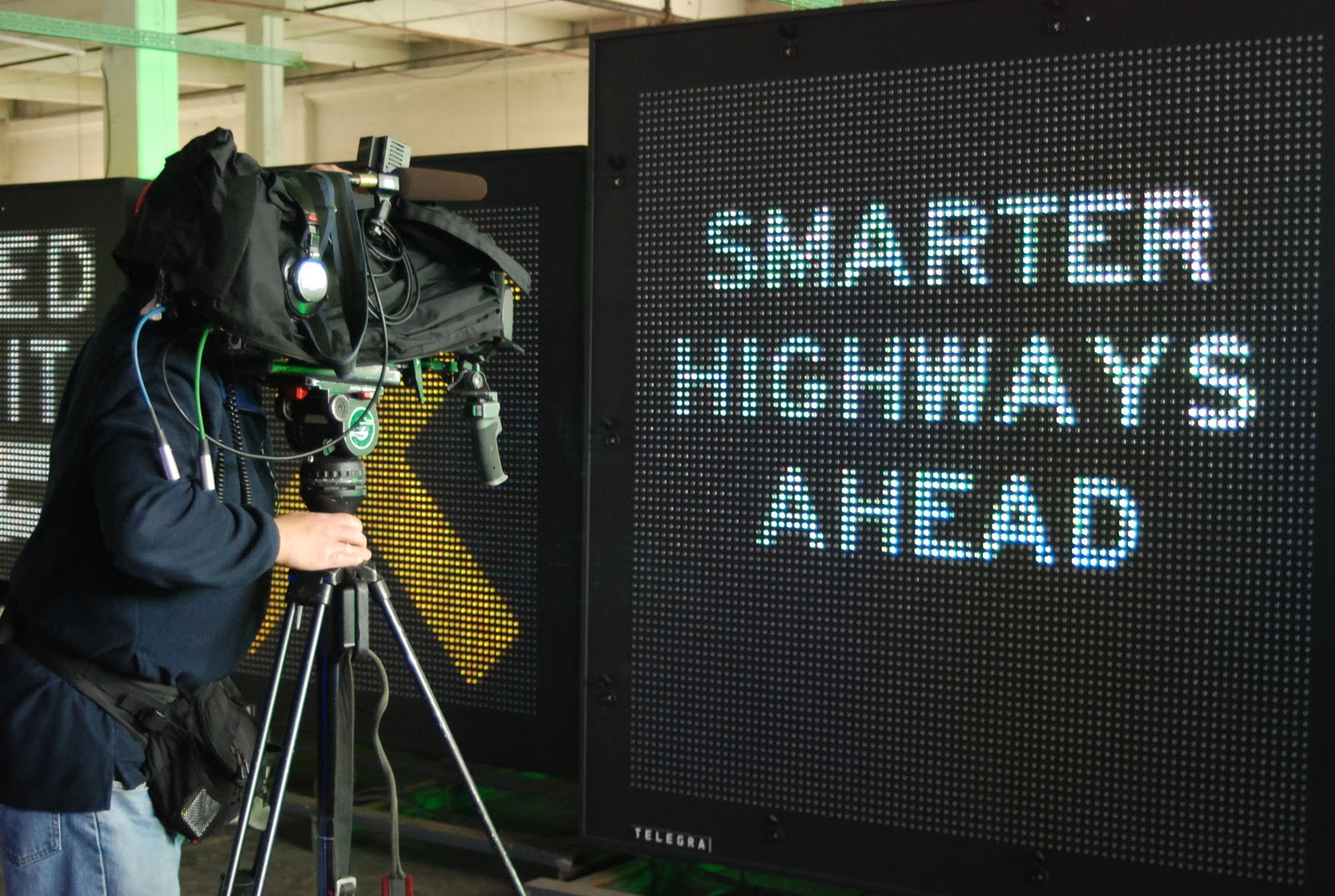
On your mark, get set, get smart. Not Maxwell Smart. We’re talking Smarter Highways.
If you’ve driven northbound I-5 between Boeing Access Road and I-90 recently, you’ve probably noticed a whole bunch of new electronic signs over the freeway. These are our Smarter Highways signs. Since we began testing them in May, the new signs have displayed bunches of random dots, asterisks and other cryptic test messages.
Starting Aug. 10, the test messages will go away and the new signs will officially get smart. That means it’s time for you to get smart, too.
When the signs go live, they’ll be giving drivers real-time traffic information about what’s happening on the road ahead through a series of Xs, arrows and electronic messages. If you’re wondering what that’ll look like, you can check out a video of how the signs will work on the Smarter Highways website.
So what makes these signs smarter than the electronic signs we already have on I-5? For one thing, they’re stationed every half-mile along I-5. That means we can get more specific traffic information to drivers well before they get stuck in congestion. And because we have a sign positioned above each lane on the freeway, we can let drivers know exactly which lanes are blocked and which lanes are open. We can even let drivers know to adjust their speed before they reach slower-moving traffic.
This information means that drivers can change lanes ahead of time or even get off the freeway to avoid congestion. It’ll also help reduce the number of rear-end crashes that can happen when drivers suddenly find themselves in slowing traffic.
As regular commuters probably know, crashes cause congestion, congestion in turn causes more crashes, and those crashes in turn cause more congestion. It’s a vicious cycle, especially during rush hour. Since building nine miles of new lanes on I-5 isn’t a feasible or affordable option, we had to find a way to make our highways work more efficiently. There’s an old saying: Don’t work harder, work smarter. And that’s exactly what these signs will do for our highways.
We’re getting smart. How about you?

 |
 |
 |
 |
 |
 |
 |
 |
 |
 |
 |
 |
 |
 |
 |


