Showing posts with label culvert. Show all posts
WSDOT maintenance crews don’t leave it to beaver
Posted by Unknown in Bear Creek, beaver, beaver dam, culvert, dam, SR 522, SR 9, Woodinville on Friday, January 9, 2015
By Justin Fujioka
 |
| The upstream side of the culvert was blocked using a steel plate attached to the end of an articulated crane to control the release of water and prevent a sudden flood, which could have put our crews and properties downstream of Bear Creek in danger. |
A dam blocking an 80-foot-long culvert in Woodinville this week was enough to drive Ward and June Cleaver up the wall, and our maintenance crews simply couldn’t leave it to beaver.
The beaver constructed the dam in the center of the culvert that runs under SR 9, just north of SR 522, near Woodinville. No word if he received help from Whitey and Lumpy. The critter’s creation was so clever and well-built that it prevented a large amount of water from an upstream pond from getting through the culvert. This caused the water level of the pond to rise and that’s when we knew this was not just your average beaver dam. So our maintenance team went to work.
In order to safely clear the beaver dam, crews blocked the upstream side of the culvert to control the release of water to prevent a sudden flood, which could have put our crews in danger and affected properties downstream of Bear Creek. The culvert was blocked using a steel plate attached to the end of an articulated crane from a truck, which required the closure of the right lane of northbound SR 9, just north of SR 522.
On the downstream side of the culvert, crews used a grapple hook on the end of a rope attached to a chainsaw winch (basically a giant fishing rod) to grab small chucks of the beaver dam as they slowly broke down the structure.
 |
| Grapple hook used to remove small chucks of the beaver dam. |
Brave and cold crewmembers walked the grapple hook into the five-foot-wide culvert and dug it into the debris. After safely walking back out of the culvert, the crew started up the chainsaw winch to pull out the grapple hook. Most of the time, it carried out nothing more than a handful of rubble.
Because the dam was estimated to have filled a fourth of the culvert, the process was like chipping away at concrete. Occasionally, the crew would lift the steel plate up to allow water to flow into the culvert with hopes that the force would clear more debris. After eight hours of hard work, the crew’s slow and meticulous approach allowed for the water to flush out the beaver dam.
 |
| A rope tied onto the grapple hook was attached to a chainsaw winch to allow our maintenance crew to move out of the culvert and into safety before small chucks of the beaver dam were removed. |
Why was it necessary to remove the beaver dam? Good question. If we would have left the rodent’s dam intact it could have caused water to undermine and damage the highway above it (SR 9) and it could have created potentially damaging flooding downstream. In the past, our crews have removed or modified beaver dams near roadways, but never under one. If you’re interested in more info on when we remove beaver dams, check out this document.
So where’s the eager beaver? Hard to say. Some speculated it was hanging out with Wally and Eddie Haskell. More likely, when humans moved in, it moved on. Typically, we work closely with the Washington Department of Fish and Wildlife to make sure animals are relocated if necessary. In this case, the beaver wasn’t spotted near its dam. Those who frequent the area say they often see a beaver, but it’s usually hanging out in the pond upstream of the culvert. Wherever it is, we salute you and your engineering prowess, Mr. Beaver, but ask that in the future, you show off your skills in less potentially-hazardous spots.
View the video of the beaver dam inside the culvert and how our crews removed it.
Washington’s newest mega project: Fish barrier corrections
Posted by Unknown in culvert, culvert replacement, culverts, fish barrier corrections, fish passage, fish-friendly on Wednesday, September 17, 2014
By Ann Briggs
You've probably heard about our four “mega projects:” Alaskan Way Viaduct, State Route 520 Bridge, Interstate 405 Corridor and the North Spokane Corridor, but did you hear about the newest one? It's called “Fish Passage” and it's currently unfunded.
Statewide, there are about 6,500 culverts on the state highway system. Of those, about 3,200 are in fish-bearing streams. We're required by law to maintain culverts, fish ways and bridges so that fish have unrestricted passage to upstream and downstream habitat.
 |
| SR 530 Moose Creek culvert before correction. |
The amount available for this work in the current biennium is $36 million. Right now we estimate approximately $300 million is needed each two-year budget cycle through 2029-31. The initial estimated cost to comply with the injunction is $2.4 billion at the low end, and likely to go up. As we do more detailed design work on a first round of 34 projects, we are finding that costs are higher than initial estimates for those projects. That's mostly due to limited site-specific information when the initial cost estimates were developed. We anticipate cost estimates for the entire program will stabilize as we learn more about individual site characteristics.
We've been working to improve access to habitat for fish since the 1990s. About 280 fish-barrier correction projects have opened access to more than 975 miles of potential fish habitat.
 |
| SR 530 Moose Creek culvert after correction. |
Why do we do this? It's part of our agency's goals to protect natural habitat and water quality. It also supports the Governor's goals for the environment and salmon recovery.
So how did we get here? You have to remember that much of our state's infrastructure was built decades ago. Many of these culverts were installed simply for the purpose of conveying water, before we had the science and understanding of the needs of fish.
In some areas, like Interstate 90 at Snoqualmie Pass, projects that improve fish passage have improved conditions for other species, allowing deer, bear and other wildlife to cross safely under or over the busy freeway lanes – that's safer for drivers too!
Visit our Fish Passage project website for an interactive map of all barrier locations and project details.
Fish love our new bridge on Mount Baker Highway
Posted by Unknown in culvert, fish, Mount Baker Highway on Friday, November 5, 2010
It didn’t take long for fish to find their way back to Chain-up Creek once the barriers were removed.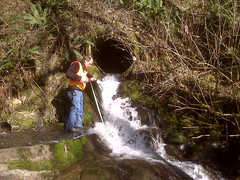
For years, a small concrete culvert and steep drop-off made it nearly impossible for fish to return home.
But a brand new bridge along Mount Baker Highway has revived Chain-up Creek and made the journey home to native habitat easier for spawning fish.
Fish have already been spotted and photographed swimming in the creek only a month after WSDOT completed work on the new bridge and reopened the creek.
During construction, crews were careful to rebuild the creek bed. We strategically placed all the boulders, rocks and logs to mimic and foster the natural flow of a creek. And it’s paying off.
We worked all summer to shift a half-mile stretch of Mount Baker Highway away from the Nooksack River and build the new bridge at Chain-up Creek. We recently opened the new bridge, several miles east of Glacier, to traffic.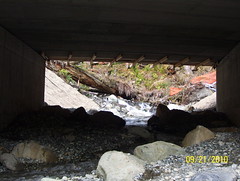 It’s not just the fish who benefit from the new bridge, either. These improvements will make a big difference to drivers and residents in the area. The new bridge and rebuilt creek will reduce the risk of flood damage to the road and reduce the potential for emergency road closures. They should prevent costly emergency repairs and repeated lane closures. It’s a win-win for drivers and the environment.

 |
 |
 |
 |
 |
 |
 |
 |
 |
 |
 |
 |
 |
 |
 |


