Showing posts with label Demolition. Show all posts
Crunchers SMASH in Salmon Creek
Posted by Unknown in concrete processors, Demolition, I-205, I-5, I-5/I-205 junction, NE 139th Street Interchange, on-ramp, Salmon Creek on Wednesday, September 25, 2013
by guest blogger Heidi Sause
I met a man today who operates a concrete cruncher.
I know what you’re thinking, and I agree – that sounds like the coolest job ever! Concrete crunchers (technically, concrete processors) are built for maximum-strength, precision demolition work. Look at the jaws on this baby!
 |
| Cruncher jaws! |
 |
| Half a bridge |
The demolition work is part of a congestion-relief project in Salmon Creek. We’ve enlisted the crunchers because we need to remove an old on-ramp to make room for the new NE 139th Street interchange that’s being built over the I-5/I-205 junction. Also, The Hulk was busy.
In this photo, you can see the construction of the new interchange peeking out beneath the partially demolished ramp.
 |
| Old and New |
Fun fact: 100% of the concrete, steel and wood bits removed from the bridge are being shipped to plants to be recycled in future projects. See, Dr. Banner? You’re not the only one who gets to smash and be green! *Rimshot*
State Route 99 – Two years in the transformation of Seattle’s first freeway
Posted by Unknown in Alaskan Way Viaduct, Demolition, Seattle, SR 99, viaduct on Friday, September 21, 2012
By guest blogger Greg Phipps
In summer 2010 contractor crews working for WSDOT started work to replace the aging Alaskan Way Viaduct south of Downtown Seattle. Two years later the seismically vulnerable viaduct is gone and drivers are traveling on a brand new, seismically-strong State Route 99 from SODO to Pioneer Square. This section of SR 99 won’t be truly complete until it connects to the SR 99 tunnel at the end of 2015. Still, it’s pretty cool to see how replacing the southern mile of the viaduct has changed the landscape south of downtown.
The southern mile
Our first photo shows the southern mile of the viaduct in May 2010, before crews started building the new SR 99. Besides the viaduct, keep an eye on a couple things that will change. The first thing is Alaskan Way South, the street on the west side of the viaduct. The second thing is the railroad tracks between the viaduct and Alaskan Way South.
The southern mile in September 2011
One year ago crews were close to finishing the western half of the new SR 99, the piece that would eventually become the southbound lanes of the highway. What happened to Alaskan Way South? Part of it is in the footprint of the new SR 99 bridge, while the rest has become a construction zone. And the railroad tracks? They’ve moved west, out of the way of the new highway.

Southern mile demolition – October 2011
Just one month later and the viaduct is a shell of its former self, literally. Demolition machines are hammering and crunching the double-deck viaduct into piles of concrete and rebar rubble. In a little more than a week most of the southern mile has disappeared. Meanwhile, crews are getting ready to open the western half of the new highway and the construction bypass that takes traffic from the new highway up to the remaining section of the viaduct north of South King Street.

The new Highway 99 - September 2012
It’s 11 months after the southern mile demolition and we’ve got twins! Bridges, that is. Southbound traffic rides on the west bridge and northbound traffic uses the east bridge, until they meet again and travel on a construction bypass around SR 99 tunnel construction. On the photo trace a line from the end of the east bridge through the tunnel construction zone toward the blue cranes on the bottom right. That’s your route into the tunnel starting at the end of 2015.

Recycling bridges the gap between cost and environment
Posted by Unknown in aurora bridge, Bellevue, Demolition, I-405, Recycling, Sustainable Transportation, wsdot on Thursday, April 28, 2011
By guest blogger Noel Brady
You recycle those paper cups, bottles and old documents to keep them out of the landfill. Curious to find out how much landfill space a 300-foot-long, four-lane bridge would take?
Neither was our I-405 project team. That’s why we recycled 100 percent of the NE 12th Street bridge in downtown Bellevue after crews demolished it in March to make way for a longer, wider bridge to connect new ramps to I-405 and SR 520.
After bringing down the bridge, crews hauled away nearly 4,000 tons of concrete, 225 tons of rebar and truck loads of wood to recyclers. In addition to cutting carbon emissions from production, recycling construction materials saves money. 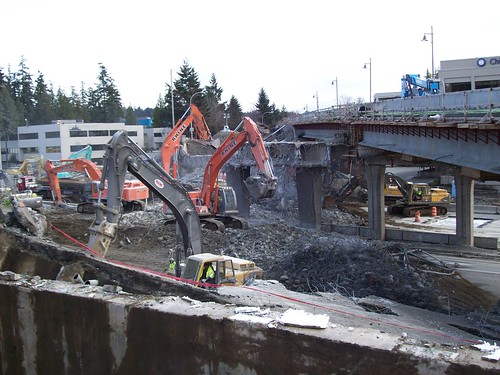
“In the old days it would’ve been taken to a landfill”, said Seema Javeri, WSDOT Project engineer. “Now we’re recycling road and bridge materials and even going back and restoring DOT property that was used for dumping 25 years ago.”
The state does not require recycling in bridge demolition, but it is becoming the norm as the market for recycled materials grows. Today we routinely write construction specifications that make it easier to recycle materials. Plans often require concrete be laid in panels for efficient removal and recycling, and they allow a higher percentage of recycled materials in cement than was the standard in the past.
“It’s one thing to recycle material,” said Steve Mader, an environmental manager for I-405 Corridor Design-Builders, “but it’s better to upcycle” or preserve materials during demolition to keep them in good condition for reuse. His firm routinely crumbles concrete on site for use as base rock. And his crews take care not to twist and mangle used rebar, which can increase its market value as much as five times.
Starting back in the 2002 with its Record of Decision, the I-405 program has followed a guiding principle to leave the environment better then it was found, Javeri said. That means building better drainage and filtration systems, planting more vegetation and recycling more materials.
Visit the Sustainable Transportation Web page to learn how we support the environment, economy and communities in our mission to keep Washington moving.

 |
 |
 |
 |
 |
 |
 |
 |
 |
 |
 |
 |
 |
 |
 |


